What does “sustainable” really mean in a mountain community?
In places shaped by landscape, sustainability isn’t a feature. It’s a foundation.
The word “sustainable” appears everywhere—on signage, in marketing materials, across entire developments. But in mountain environments like Fernie, the stakes are higher.
These are places defined by fragile ecosystems, limited access, sensitive watersheds and wildlife movement patterns that have existed long before any road or building. What happens here—how land is used, how communities are planned—has consequences that extend well beyond property lines.
So what does sustainability actually mean in a setting like this? More important: how do you recognize it?
It begins with what is not built
In many developments, sustainability is framed around what’s added—technologies, materials, certifications.
In mountain landscapes, it often starts with something else entirely: what is left untouched.
Preserving large, contiguous areas of natural land rather than fragmenting them into smaller pieces is one of the most meaningful decisions a community can make. These preserved areas maintain ecological function, protect wildlife corridors and allow natural systems to continue operating as they always have.
Because once these systems are broken, they’re rarely restored.
It respects water as a system, not a feature
Rivers and creeks are often treated as amenities—something to be viewed, accessed or built around.
In reality, they’re dynamic systems.
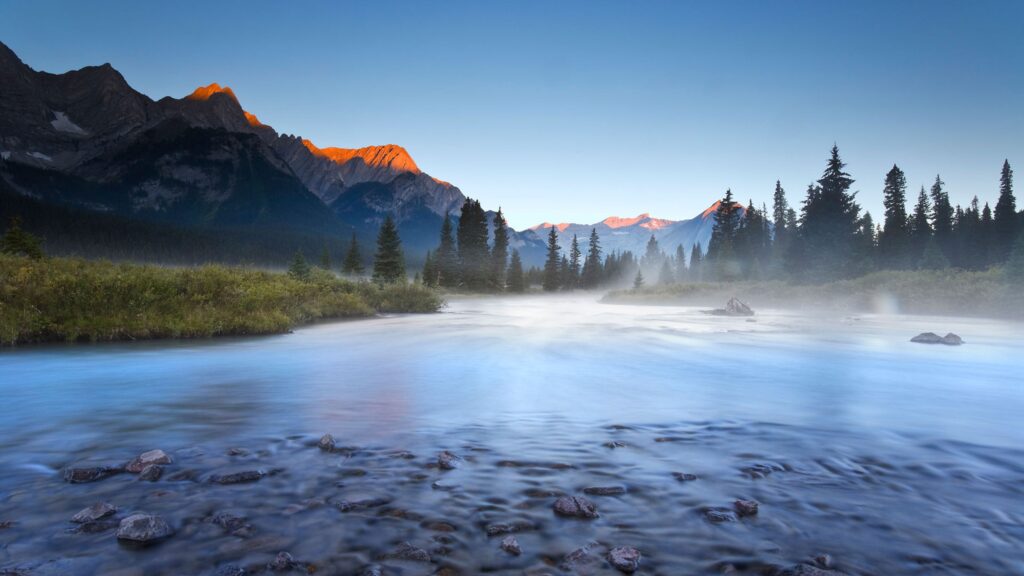
Healthy watersheds depend on intact riparian zones, stable banks, natural flow patterns and minimal disturbance upstream. Even small changes can affect water quality, temperature and habitat viability.
True sustainability recognizes that water cannot be managed in isolation. It must be protected as part of a larger, interconnected system.
It plans for decades, not phases
Development often unfolds in stages… phases, releases, timelines.
Sustainability operates on a different horizon. It considers what the landscape will look like in 20, 50 or 100 years. It asks whether decisions made today will still make sense as forests mature, as climate patterns shift and as communities evolve.
This long-term view influences everything from infrastructure placement to forest retention to how open space is funded and maintained over time.
It treats density with care—not as a default
In urban settings, higher density is often associated with sustainability.
In mountain environments, the equation is more nuanced.
Too much density can strain infrastructure, disrupt wildlife movement and erode the very qualities that make these places desirable. Too little can lead to inefficient land use.
The goal is not maximum density but appropriate density, balanced with preserved land, thoughtful siting and a clear understanding of the landscape’s capacity.
It understands that design is environmental
Sustainability is often discussed in terms of systems—energy, water, materials.
But in mountain communities, design itself plays a critical role.
How a home is positioned. How much of the forest is retained. How buildings relate to topography, sunlight and wind.
Simple, well-sited structures that work with the land tend to have a lighter environmental footprint than complex forms that require significant alteration to the site.
In this context, restraint is not aesthetic. It’s ecological.
It considers the experience of the place
There’s another dimension to sustainability that’s less frequently discussed: what it feels like to be there.
Overlit roads that erase the night sky. Constant noise that displaces wildlife. Landscapes that feel engineered rather than discovered.
These may not always show up in environmental metrics, but they shape the long-term relationship between people and place.
Sustainable communities protect not just ecological systems but sensory ones—darkness, quiet, immersion, the ability to move through a landscape without feeling removed from it.
It creates a culture of stewardship
No plan—no matter how well considered—can sustain a landscape on its own.
People do.
Sustainability depends on shared understanding: how residents build, how they light their homes, how they move through the land and how they value what surrounds them.
The most enduring communities are those where stewardship is not enforced but embraced.
It earns the word
In the end, sustainability is not something a development declares.
It’s something it demonstrates—over time, through decisions that are often less visible but far more consequential.
It’s found in preserved land. In protected water systems. In buildings that feel like they belong.
In a landscape that continues to function as a living system.
And perhaps most tellingly, in what remains unchanged.
A final thought
In a place like Fernie, the question is not whether development can happen.
It’s whether it can happen in a way that respects what is already there and ensures it remains for those who come next.
That’s the real measure of sustainability.
Explore more: